How Conveyor Components Improve Manufacturing Efficiency
June 25,2026
Manufacturing facilities operate on razor-thin margins. Every minute of downtime costs money. Every inefficient process reduces output. Every quality issue damages reputation. Conveyor components address all these problems simultaneously.
Most manufacturers never think about the conveyor belts, chains, and components running their operations. They expect them to work. When they do, production flows. And when they do not work, everything comes to a halt. Learning how these components make a conveyor system more efficient allows you to optimise your business.
Speed and Productivity
Conveyor systems move items throughout manufacturing operations at a certain pace. A human worker cannot do this consistently. An employee will carry just one product at any time. A conveyor can carry dozens at once.
Through this speed, productivity is enhanced. A bottling system which operates at 100 bottles per hour through manual conveyors becomes capable of handling 500 bottles an hour with appropriate conveyor components.
Speed also creates flexibility. During peak demand, you accelerate conveyor speed and during slow periods, you can reduce it.
Consistency and Quality
Manual handling introduces variability. Different workers move products at different speeds. Handling is inconsistent. Product damage varies. Quality control becomes difficult.
Conveyor systems deliver consistency. Every product moves at the same speed. Handling is identical every time. Damage is predictable and minimised. Quality improves because variability decreases.
This consistency builds customer trust. Products arrive in consistent condition. Complaints decrease. Reputation strengthens. Repeat business increases.
Reduced Labour Costs
Conveyor systems eliminate repetitive manual work. Workers do not spend hours moving products. They focus on value-added tasks. Inspection. Packaging. Quality control.
Over time, labour costs decrease even as total output increases. You produce more with fewer workers in physically demanding roles.
Minimised Downtime
Manual conveyance creates bottlenecks. A worker falls behind. The entire line backs up. Production halts until the bottleneck resolves.
Automated conveyor systems eliminate these bottlenecks. Products flow continuously. No backups. No stalls. Production maintains a steady pace regardless of individual performance variations.
Sufficient availability of parts ensure that when conveyor components fail the modern modular designs allow quick replacement. A broken section swaps out in minutes. Production resumes. Downtime becomes measured in minutes, not hours.
Product Safety and Integrity
Conveyor systems handle products safely. No dropping. No rough handling. No bruising or damage.
For fragile products, this matters enormously. Electronics, ceramics, cosmetics. Any product sensitive to handling benefits from gentle, consistent conveyor movement.
Product safety also means food safety. Automated conveyance reduces cross-contamination. Products move on clean, dedicated paths. Hygiene improves. Compliance becomes easier.
Flexibility for Different Products
Modern conveyor components work with diverse products. Wide products. Narrow products. Delicate items. Heavy boxes. Different shapes and sizes.
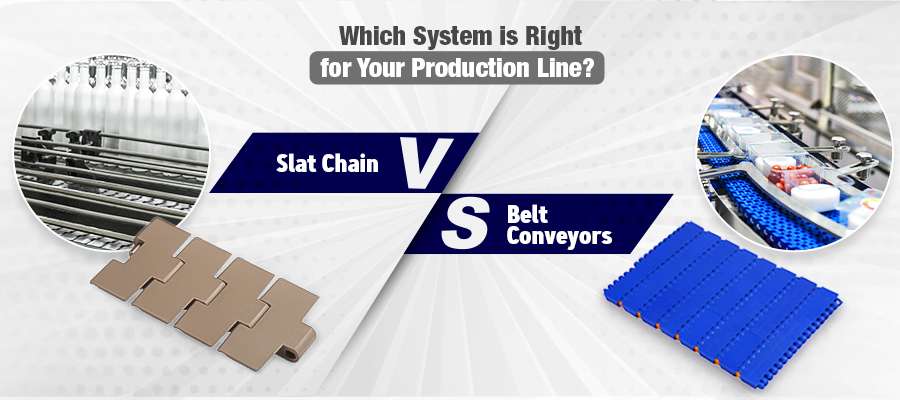
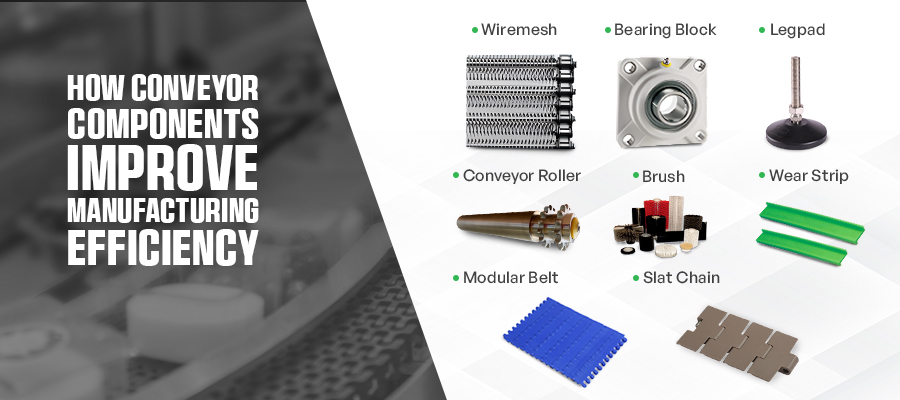
Modular belt systems, slat chains, and specialised components adapt to requirements. You change product lines without replacing entire systems. This flexibility enables manufacturers to serve multiple markets with the same facility.
Space Efficiency
Conveyor systems work in confined spaces. Vertical conveyors stack height. Curved sections navigate tight corners. Multiple levels of conveyors fit in the same footprint as single-level manual operations.
Energy Optimisation
Modern conveyor components are remarkably efficient. High-quality slat chains and belts reduce friction. Motors work less hard. Energy consumption decreases.
Optimised designs mean lower operating costs. Electric bills decrease. Carbon footprint improves. These align with sustainability goals increasingly important to customers.
Integration with Automation
Conveyor systems integrate with automated processes. Sorting systems. Packaging machines. Labelling equipment. The conveyor becomes the backbone connecting all these systems.
The Bottom Line
Conveyor components are not luxury additions to manufacturing facilities. They are essential infrastructure driving efficiency across every metric that matters. Speed, consistency, quality, cost, flexibility, and safety.
Investment in quality conveyor parts is rewarded with greater production, lower costs, and higher product quality. These efficiencies will add up for many years to come.
For those in manufacturing who take competition seriously, improving conveyors is an absolute necessity. Contact our expert team at Spectra Plast to find the best conveyor components for your business.
For more information, please visit Spectra Plast India Pvt Ltd.
Recent Posts