Wire Mesh Conveyor Belts: Benefits and Applications
Oct 10,2026
Wire mesh conveyor belts seem simple in concept. Just metal wires weaved into a grid formation. But the simplicity of wire mesh is what makes it solve issues that other belt types are unable to solve. Knowledge on wire mesh advantages will help you make the right choice when choosing a conveyor.
The use of wire mesh belts in some industries is well justified by their advantages over other belts. They prove very useful in cases where others cannot be used.
What Wire Mesh Offers
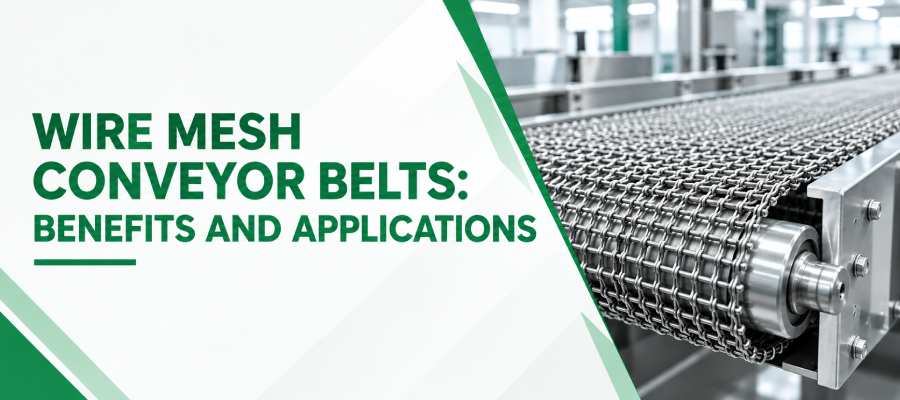
Wire mesh construction creates an open design. Products sit on the wires rather than a solid surface. This openness allows air and liquid to pass through. Heat can reach products from below. Moisture drains away naturally. Traditional belts cannot do this.
The open design prevents accumulation of debris underneath products. Spills fall through instead of building up. Cleaning becomes straightforward. You rinse the belt and debris drains away. No sticky residue remains.
Wire mesh tolerates temperature extremes that would destroy rubber belts. High-temperature applications like ovens and dryers use wire mesh belts exclusively. The metal does not degrade from heat exposure. It does not melt or soften.
Durability is exceptional. Wire mesh withstands abrasion far better than woven materials. Sharp product edges that shred fabric belts barely mark wire mesh. This longevity reduces replacement frequency and operational costs.
Common Applications
Wire mesh belts play a very crucial role in food processing. In bakeries, they are used inside ovens. The mesh construction facilitates the flow of heat around the products. Moisture evaporates upwards and, thus, there are proper crusts formed on baked products without wet bottoms. Cleaning plays a very crucial role in food processing. It is easy to clean wire mesh without trapping any contaminating materials.
Wire mesh belts have been widely used in food freezing. Products are moved through freezing tunnels using wire mesh belts. Air flows freely around the products, thereby facilitating rapid freezing. Traditional belts do not facilitate this.
Heat treatment is dependent on wire mesh since metal parts, ceramics, and any other substances that require heat treatment run on wire belts. This enables exact temperatures to be achieved since the heat can reach all parts of the product.
Wire mesh is used in chemical processing when there is the need for drainage. The chemicals will not pool but drain off and thus contamination will be avoided as well as exact dosages.
Printing and coating operations employ wire mesh when product contact must be minimal. Paint, glaze, and ink systems benefit. The belt supports products without blocking coating application. Finished surfaces are pristine because the belt never interferes.
Performance Advantages
Efficiency improves with wire mesh. The open design reduces friction compared to solid belts. Motors work less hard. Energy consumption decreases. Operating costs decline over time despite higher initial investment.
Product quality improves. Heat treatment becomes uniform. Drainage prevents defects. Contamination is minimised. These quality improvements often justify wire mesh selection regardless of cost.
Maintenance is straightforward. Accumulated buildup rarely occurs. Inspection is simple because you can see through the belt. Replacement of worn sections is often possible without replacing the entire belt.
Hygienic standards are easier to maintain. Food safety regulations favour open designs. Cleaning validation is simpler. Inspection for contamination is direct. These factors make wire mesh preferred in regulated industries.
Material Considerations
Stainless steel wire mesh dominates food and pharmaceutical applications. It is resistant to corrosion and can handle cleaning solvents. This makes it expensive; however, it is necessary in industries that have to pass hygiene standards.
Carbon steel wire mesh can be used for heat treatment purposes and general manufacturing. It is relatively cheaper than others, although it is sufficient in non-corrosive conditions.
For certain chemicals, there are specialized metals. Some require use of nickel alloy or other exotic metals. The metal used is determined by its scarcity and performance.
The Bottom Line
Wire mesh conveyor belts offer real solutions to real problems. They facilitate processes that cannot be accomplished using any other kind of belt. Tolerance to high temperatures, good drainage and ease of cleaning makes them indispensable for many applications.
Spectraplast provides you with wire mesh conveyor belts of superior quality that are engineered for tough applications. Perfectly engineered for perfect performance, our choice of materials perfectly suits your application needs.
For more information, please visit Spectra Plast India Pvt Ltd.
Recent Posts